When the heat hits, many warehouse, workshop, or factory managers rush to buy any fan, thinking that’s the solution. But the truth is, making the wrong choice can be expensive… and leave the space just as stifling as before.
Here are the 5 most common mistakes when buying industrial fans and how to avoid them to keep the air fresh and productivity high all summer long.
-
Buying household fans thinking they’ll work in an industrial environment
That pedestal fan that works fine in your living room isn’t built to run 8–10 hours straight in a space filled with dust, grease, and extreme heat. The motor overheats and the airflow barely reaches where it’s needed.
How to avoid it: Choose industrial fans designed to move large volumes of air and withstand heavy-duty use. Their reinforced motors and robust construction make all the difference.
-
Ignoring the size and layout of the space
Placing a small fan in a 500 m² warehouse is like pouring a glass of water on a desert. Plus, if there’s machinery or shelving, hot air can get trapped in heat pockets that a household unit can’t dissipate.
How to avoid it: Measure the area and identify critical zones where heat builds up the most. Often, the best solution is to combine several portable fans to create cross-airflow.
-
Choosing based on price alone (and paying double later)
“The cheapest one will do…” until the motor burns out in the second month. Units not designed for continuous use end up costing more in repairs or replacements.
How to avoid it: Invest in fans with shielded motors and high-quality materials. The initial price difference pays off with better durability and efficiency.
-
Forgetting about mobility
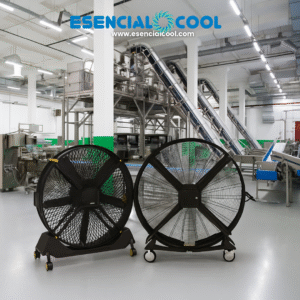
In warehouses and logistics areas, heat doesn’t stay in one spot: it shifts with the sun, machinery, and activity. If the fan is fixed, you won’t be able to move cool air to where it’s most needed.
How to avoid it: Industrial portable fans with wheels are ideal for keeping up with shifting heat and cooling critical zones throughout the day.
-
Overlooking noise levels
An industrial fan will always generate some sound when moving large volumes of air, but a well-chosen unit shouldn’t be disruptive to the people working nearby.
How to avoid it: Check the decibel (dB) levels before buying and look for a balance between power and acoustic comfort.
Avoid Mistakes and Get It Right the First Time
Every space has its own needs. That’s why at Esencial we’ve put together a full range of industrial fans — fixed and portable — designed to keep your facilities cool and comfortable even on the hottest days.
If you need guidance, our team is here to help you choose the best solution for your warehouse or workshop.
The Esencial Cool Team

Visit us: www.esencialcool.com
Call or WhatsApp us: +(34) 633 938 824